Journal of Humanitarian Medicine - vol. XI - n. 4 - October-December 2011

BOOK REVIEWS
Published by the World health organization
Pubblicazioni - Journal - Vol. XI N.4
Journal of Humanitarian Medicine - vol. XI - n. 4 - October-December 2011 |
|
|
BOOK REVIEWS Published by the World health organization |
|
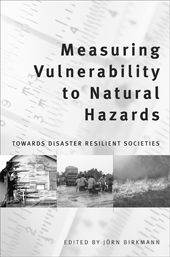
MEASURING VULNERABILITY TO NATURAL HAZARDS Towards Disaster Resilient Societies |
|
|
“This completely revised book on measuring vulnerability to natural hazards, edited by Jörn Birkmann, who has brought together more than 30 authors working in this field, is an excellent and very positive addition to the scientific literature on disaster risk reduction. The strategic connections with climate change adaptation are very timely and comprehensive. The focus on vulnerability and its assessment makes it highly relevant to scholars and also towards the development of strategic policy.” Gordon McBean, Institute for Catastrophes, Loss Reduction, University of Western Ontario and Chair, Science Committee, Integrated Research on Disaster Risk Programme. “Climate change adaptation”, building resilience” and “vulnerability and risk reduction” are noble words, but do we really know what is meant by these terms and how to assess their respective progress? Measuring vulnerability to Natural Hazards seeks to address these questions. The world has recently experienced disasters of a magnitude rarely seen before; the cascading disaster in Japan, the earthquake in Haiti, and floods in Pakistan and Australia are a few prominent examples. |
|
These major disasters underline the fact that many communities and world regions are still vulnerable to extreme events and natural hazards. The dynamic and complex interaction between vulnerable communities, and climate- and non-climate-related, suddenonset and creeping hazards very probably increases the risk of crises and disasters in the future.
Measuring Vulnerability to Natural Hazards is a completely revised, second edition of the popular book of the same title. Aside from being fully updated, this new edition includes the dimension of adaptation to climate change and new risks resulting from climate change. The text provides and combines practical examples from Africa, Asia, the Americas and Europe with theoretical and conceptual frameworks. It is key reading for all those interested in improving risk reduction and adaptation strategies to extreme events and gradual changes in the context of climate change and natural hazards. Measuring vulnerability and evaluating adaptation are essential prerequisites to strengthen the capacities of communities in building resilience through knowledge-based approaches. Jörn Birkmann is Academic Officer and Head of the Vulnerability Assessment, Risk Management and Adaptive Planning Section at the United Nations University Institute for Environment and Human Security (UNU-EHS), and Visiting Adjunct Professor at the Department of Geography, University of Bonn, Jörn Birkmann is IPCC Lead Author for the IPCC Special Report Managing the Risk of Extreme Events and Disasters to Advance Climate Change Adaptation and Lead Author for the IPCC Fifth Assessment Report.
|
|
|
FIXING HAITI Minustah and Beyond |
|
|
Haiti may well be the only country in the Americas with a last name. References to the land of the “black Jacobins” are almost always followed by the phrase “the poorest country in the Western Hemisphere”. To that dubious distinction, on 12 January 2010 Haiti added another, when it was hit by the most devastating natural disaster in the Americas, a 7.0 Richter scale earthquake. More than 220,000 people lost their lives and much of its vibrant capital, Port-au-Prince, was reduced to rubble. Since 2004, the United Nations has been in Haiti through MINUSTAH, in an ambitious attempt to help Haiti raise itself by its bootstraps. This effort has now acquired additional urgency. Is Haiti a failed state? Does it deserve a Marshall-plan-like programme? What will it take to address the Haitian predicament? |
|
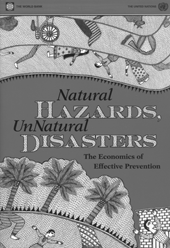
NATURAL HAZARDS, UNNATURAL DISASTERS World Bank Press |
|
|
Earthquakes, droughts, floods, and storms are natural hazards, but unnatural disasters resulting from human activity cause deaths and damage. Every disaster is unique, but each one exposes actions by government and individuals which, had they been different, would have resulted in fewer deaths and less damage. The book Natural Hazards, Un- Natural Disasters , published by the World Bank, examines disasters mostly from an economic perspective. However, it also draws on other disciplines, such as psychology (to examine how people may misperceive risks), political science (to understand voting patterns), and nutrition science to see how undernutrition in children after a disaster impairs cognitive abilities and can affect their productivity ad adults. It asks provocative questions, such as: Should all disasters be prevented? Do disasters increase or decrease conflict? Does foreign aid help or hinder prevention? The answers are not obvious. Peering into the future, it finds that growing cities and a changing climate will shape the disaster prevention landscape. This book will be of interest to government officials, urban planners, relief agencies, NGOs, donors, and other development professionals. The English version can be accessed on line at: http://issuu.com/world.bank.publications/docs/9780821380505 . |
|
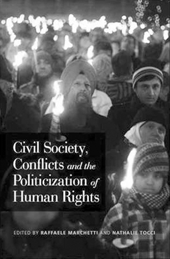
CIVIL SOCIETY, CONFLICTS AND THE POLITICIZATION OF HUMAN RIGHTS Edited by Raffaele Marchetti and Nathalie Tocci |
|
|
Civil Society, Conflicts and the Politicization of Human Rights explores violent conflict and peace. The contributors examine how violence is generated, managed, exploited and eradicated in ethno-political conflicts, and how societies can be dragged out of conflict onto the transition towards peace. The usual take on these phenomena focuses on the role of governmental actors, both national and international. While official actors remain important, Civil Society, Conflicts and the Politicization of Human Rights examines the other side of the coin: the non-governmental component in ethno-political conflicts. Civil society actors or, as they are defined in this book, “conflict society organizations” (CoSOs), are increasingly central in view of the high degree of complexity of contemporary ethno-political conflicts. CoSOs have become key players in ethno-political conflicts, both as violators and as promoters of human rights. Nevertheless, the precise relationships underpinning the human rights–civil society–conflict nexus have not been fully examined. This volume analyses the impact of civil society on ethno-political conflicts through their human rights-related activities, and identifies the means to strengthen the complementarity between civil society and international governmental actors in promoting peace. These aims are addressed by examining four case studies in the European neighbourhood: Bosnia-Herzegovina, Cyprus, Turkey’s Kurdish question and Israel–Palestine. |
|
“An outstanding analysis of the civil society’s human rights-related activities and their impact on conflict in multi-ethnic societies.” “Students of social movements, human rights, and peace and conflict studies will profit significantly from this book’s contributions.” Raffaele Marchetti is Assistant Professor of International Relations in the School of Government and the Department of Political Science at LUISS University, Italy. Nathalie Tocci is Deputy Director of the Istituto Affari Internazionali, Head of the Institute’s department “The EU and the Neighbourhood”, and Associate Editor of The International Spectator.
|
|
|
ACHIEVING GLOBAL SUSTAINABILITY POLICY RECOMMENDATIONS Edited by Takamitsu Sawa, Susumu Iai and Seiji Ikkatai |
|
|
Sustainability Science Achieving Global Sustainability reviews the current status of global sustainability and analyses the relationship between globalization and sustainability, together with arguments on the necessity of a paradigm shift in economic growth. Paradigm shifts in socio-economic development are discussed in terms of social common capital, contemporary social discipline and economic valuation of the environment. The contributors also examine various strategies for achieving a sustainable society, among them a basic strategy for mitigating climate change, a strategy of technology development toward global sustainability, and a post-2012 international policy framework. |
|
The book presents methods of adaptation for environmental change, including integrated assessment models of climate change and a risk-assessment approach to seismic hazard mitigation. Policy recommendations for global sustainability are also introduced, including those advocating a low-carbon society by 2050, a “Green New Deal” as a means of integrating policies, climate security, and a new international discipline. Takamitsu Sawa is Adviser to the Chief Director of the Kyoto Sustainability Initiative, Professor at the Graduate School of Policy Science, Ritsumeikan University, Kyoto, and Project Professor at the Institute of Economic Research, Kyoto University, Japan. Susumu Iai is Chief Director of the Kyoto Sustainability Initiative and Professor at the Disaster Prevention Research Institute, Kyoto University, Japan. Seiji Ikkatai is Professor of Economics at the Institute of Economic Research, Kyoto University, Japan.
|
|